


10 Aug Commercial Disinfecting Services in Arlington, TX: What Businesses Need to Know
Cleaning and disinfecting are not the same thing — and for Arlington businesses operating in high-traffic commercial environments, that distinction matters more than most people realize. Commercial disinfecting services go beyond routine cleaning to eliminate the pathogens that standard janitorial work leaves behind. If you manage an office, medical facility, retail store, school, church, or other commercial property in Arlington and you’re evaluating your current cleaning program, this guide covers what professional disinfection actually involves, which facilities benefit most, and what to look for in a disinfecting vendor.
Cleaning vs. Disinfecting: Understanding the Difference
The terms get used interchangeably, but they describe fundamentally different processes with different outcomes.
Cleaning physically removes visible dirt, debris, and organic material from surfaces. It reduces the microbial load on a surface but doesn’t reliably kill pathogens — it moves them, dilutes them, or wipes them away. Disinfecting uses EPA-registered chemical agents to inactivate or destroy bacteria, viruses, and fungi on surfaces that have already been cleaned. Done correctly, disinfection achieves a measurable, documented kill rate against specific organisms.
The sequence matters too. Disinfectants are significantly less effective on surfaces that haven’t been cleaned first, because organic soil interferes with the chemical action of the disinfectant. A proper protocol always follows a clean-then-disinfect sequence, with appropriate dwell time — the amount of time the disinfectant must remain wet on the surface to achieve the labeled kill rate. Wiping a surface immediately after applying disinfectant provides almost no pathogen reduction.
Most standard janitorial programs are cleaning programs. They maintain appearance. Commercial disinfecting services are a step above — they’re designed to actually reduce pathogen transmission risk in shared environments.
Why Arlington Businesses Are Prioritizing Disinfection
Arlington’s commercial landscape spans everything from corporate offices near the Entertainment District to medical facilities along major corridors, retail centers throughout the city, schools and daycares, and high-occupancy venues that see thousands of visitors per event. What these environments share is high-contact-surface density — shared desks, restrooms, lobbies, elevator buttons, door hardware, and communal spaces where pathogens transfer easily from person to surface to person.
The business case for professional disinfection is straightforward: illness-related absenteeism costs U.S. employers billions annually, and the primary transmission vector in shared workspaces is contaminated surfaces. According to research published through the CDC’s environmental hygiene guidance, regular disinfection of high-contact surfaces is one of the most evidence-supported interventions for reducing illness transmission in shared environments.
For Arlington businesses operating in customer-facing or high-density environments, consistent disinfection is both a health measure and a liability consideration. A facility that can demonstrate a documented disinfection program is in a fundamentally different position than one that can only show it gets cleaned nightly.
Which Surfaces Need Disinfection — and How Often
Not every surface in a commercial facility carries equal transmission risk. Professional disinfecting services focus attention on the areas and objects most likely to transfer pathogens between occupants:
High-Touch Surfaces
Door handles, push plates, light switches, elevator buttons, stair railings, shared equipment controls, reception counters, and any surface that multiple people contact repeatedly throughout the day. These are the primary transmission points in most commercial environments and should be disinfected daily at minimum — more frequently in high-traffic facilities.
Restrooms
Restroom fixtures, flush handles, faucet handles, soap dispensers, paper towel dispensers, and countertop surfaces accumulate contamination rapidly in any occupied building. Full disinfection of all restroom surfaces — not just cleaning — should happen every day in any facility with regular occupancy.
Break Rooms and Communal Kitchen Areas
Refrigerator handles, microwave controls, coffee machine surfaces, shared utensil areas, sink faucets, and countertops in communal food preparation areas are among the highest-risk zones in any office environment. Daily disinfection of all contact surfaces is the appropriate standard.
Workstations and Shared Desks
In environments where employees share workstations — call centers, shift-based facilities, coworking environments — desk surfaces, keyboards, mice, phone handsets, and monitor controls should be disinfected between users and at the end of each workday.
Waiting Areas and Lobby Seating
Any environment where members of the public wait — medical offices, professional service lobbies, government offices, financial institutions — concentrates potentially ill individuals on shared seating and surfaces. Armrests, side tables, sign-in surfaces, and payment terminals should be disinfected daily.
Commercial Disinfecting Services: What the Process Actually Looks Like
A professional commercial disinfecting program typically incorporates some combination of the following approaches depending on the facility type, square footage, and specific risk profile:
Electrostatic Spraying
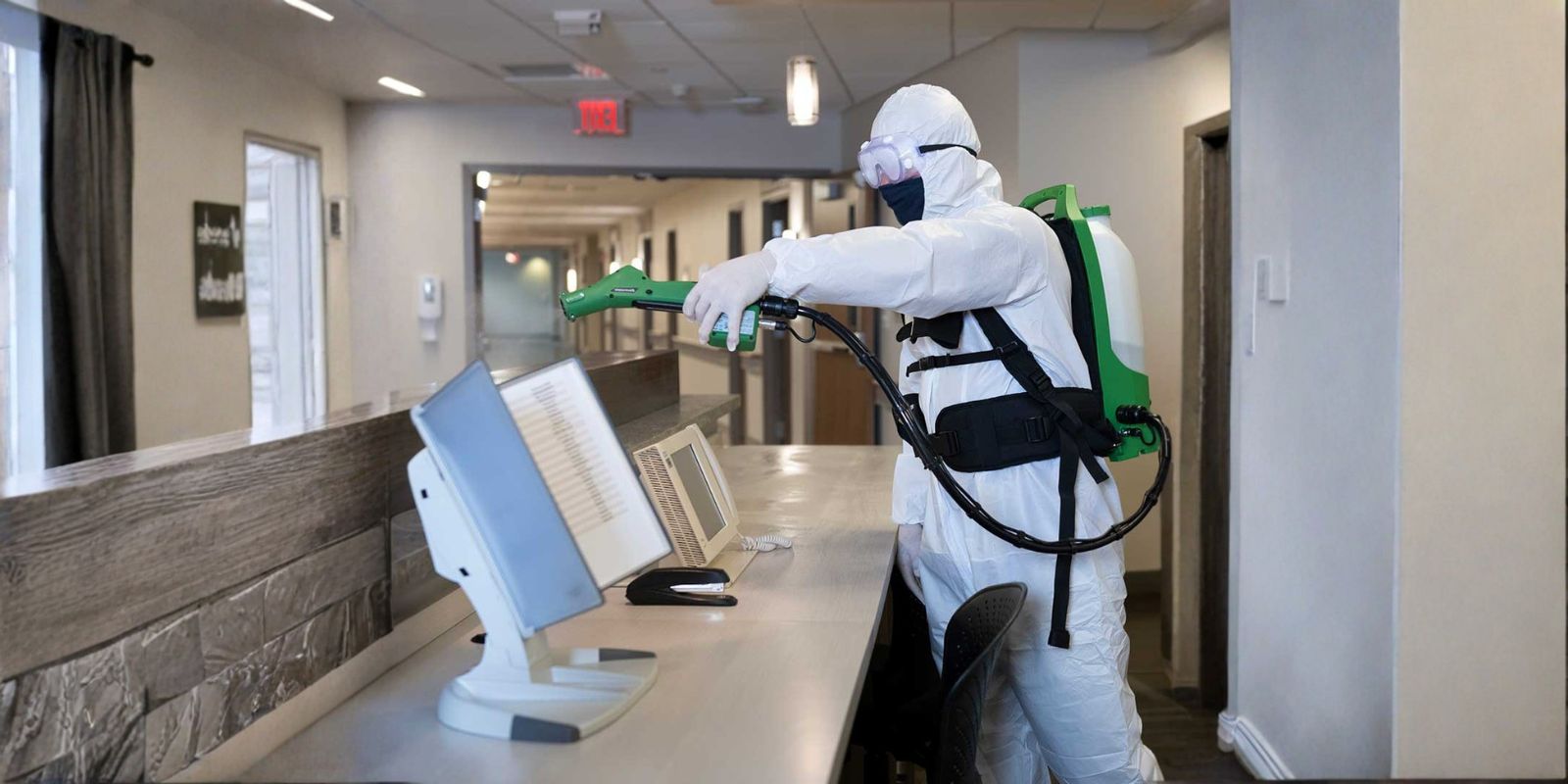
Electrostatic disinfection applies EPA-registered disinfectant solution as a charged mist that wraps around surfaces — including the back, underside, and sides of objects that conventional spraying misses. The electrostatic charge causes the droplets to cling to surfaces and achieve more complete coverage than manual application alone. It’s particularly effective for large open spaces, seating areas, and surfaces with irregular geometry.
Manual Surface Disinfection
For high-touch surfaces, manual application with microfiber cloths and EPA-registered disinfectant remains the most reliable method — particularly when dwell time compliance is required. Trained staff apply product, allow appropriate dwell time, and then wipe, ensuring the disinfectant has sufficient contact time to achieve its labeled efficacy.
Disinfectant Fogging
Fogging distributes disinfectant as a fine mist throughout an enclosed space, reaching surfaces and air in areas that are difficult to access manually. It’s most commonly used for periodic deep disinfection, post-illness events, or facilities that need full-room treatment quickly.
At Advantage Facility Services, our commercial disinfection services for Arlington businesses are built around each client’s facility profile — the right method, the right products, and the right frequency for your specific environment. We use hospital-grade, EPA-registered disinfectants with documented kill claims, applied by staff trained in proper protocol and dwell time compliance.
Industries That Benefit Most from Professional Disinfection in Arlington
Medical and Healthcare Facilities
Any patient-facing environment — physician offices, urgent care centers, dental practices, physical therapy clinics, specialty practices — requires clinical-grade disinfection as a baseline. Patient exam areas, waiting rooms, and restrooms serving ill or immunocompromised populations need documented disinfection protocols that go well beyond standard janitorial cleaning. Our medical facility cleaning programs are built around healthcare-specific disinfection requirements, including OSHA bloodborne pathogen compliance and EPA-registered product selection.
Office Buildings and Corporate Campuses
Open-plan offices, conference rooms, break rooms, and shared workstations in corporate environments create consistent cross-contamination risk during cold and flu season and year-round. Office cleaning programs that incorporate scheduled disinfection of high-touch surfaces deliver a meaningfully lower illness burden than cleaning-only programs, with measurable impact on absenteeism.
Schools and Educational Facilities
Children’s classrooms, cafeterias, and restrooms in educational settings are among the highest-transmission environments in any community. School cleaning programs in Arlington need elevated disinfection standards — EPA-registered products appropriate for youth populations, attention to all shared surfaces, and documented protocols for food service areas. Charter schools and private academies operating in Arlington benefit particularly from vendors who understand the specific demands of educational environments.
Retail Stores and Restaurants
Customer-facing retail environments — fitting rooms, checkout counters, payment terminals, shopping cart handles, and restrooms — see constant high-contact traffic from the general public. Retail cleaning programs that incorporate daily disinfection of customer-contact surfaces protect both customers and employees while maintaining the professional presentation shoppers expect.
Churches and Religious Facilities
Congregational settings bring large groups into close contact with shared surfaces — pew-end handles, hymnals, microphone equipment, nursery toys, and shared restrooms. Church cleaning programs in Arlington need particular attention to children’s areas and shared worship spaces, where disinfection goes beyond appearance to genuine pathogen reduction.
Banks and Financial Institutions
Banking environments combine high public traffic with signature pads, teller counters, ATM surfaces, and lobby seating that see constant use from members of the public. Bank cleaning programs with professional disinfection demonstrate a commitment to customer and staff safety that aligns with the trust-based nature of financial services.
What to Look for in a Commercial Disinfecting Company in Arlington
Not every cleaning company that offers “disinfection” delivers it in any meaningful way. When evaluating commercial disinfecting services for your Arlington facility, verify the following before signing a contract:
- EPA-registered products with documented kill claims: Ask for the specific disinfectants used and their EPA registration numbers. The product must be registered for use against the organisms relevant to your facility type. A vendor who can’t provide this documentation isn’t delivering clinical disinfection.
- Dwell time protocol: Ask how the vendor ensures dwell time compliance. If the answer is vague or they’re unaware of what dwell time means, that’s a red flag.
- Staff training documentation: Anyone applying chemical disinfectants in your facility should be trained in proper handling, PPE requirements, and surface-specific protocols.
- Background-checked employees: Disinfection staff often work in sensitive environments or after hours. Background checks on all personnel are non-negotiable.
- Insurance: General liability and workers’ compensation coverage should be verifiable before anyone enters your facility.
- Customized scope: A one-size-fits-all disinfection protocol doesn’t account for your facility’s specific high-risk areas, surface types, or occupancy patterns. A quality vendor builds the program around your space.
Disinfection as Part of a Complete Facility Program
Professional disinfection works best when it’s integrated into a complete facility care program rather than treated as a standalone add-on. Advantage Facility Services provides full-service janitorial programs for Arlington businesses that combine routine cleaning, scheduled disinfection, hard surface floor care, commercial carpet cleaning, window cleaning, and day porter services for facilities that need daytime coverage — all under one vendor relationship, with consistent staff and accountable management.
We serve businesses throughout Arlington and across the DFW Metroplex, including Grand Prairie, Irving, Hurst, Bedford, Dallas, and Fort Worth.
Frequently Asked Questions About Commercial Disinfecting Services in Arlington, TX
What is the difference between commercial cleaning and commercial disinfecting?
Commercial cleaning removes visible dirt and debris from surfaces, reducing microbial load without reliably killing pathogens. Commercial disinfecting uses EPA-registered chemical agents to inactivate or destroy bacteria, viruses, and fungi on pre-cleaned surfaces. Most standard janitorial programs are cleaning programs. Professional disinfection is an additional step that achieves documented pathogen reduction.
How often should a commercial facility in Arlington be disinfected?
High-touch surfaces in any occupied facility should be disinfected daily. Restrooms and break rooms require daily disinfection in any building with regular occupancy. Higher-risk environments — medical facilities, schools, childcare facilities — may require more frequent disinfection of specific areas. The right frequency depends on your facility type, occupancy, and specific risk profile.
What disinfectants should a commercial disinfecting company use?
EPA-registered disinfectants with documented kill claims against the organisms relevant to your facility type. The EPA maintains a list of registered disinfectants by pathogen type. Ask any prospective vendor for their product list and EPA registration numbers. Generic all-purpose cleaners or household disinfectants are not appropriate for professional commercial disinfection programs.
What is dwell time and why does it matter?
Dwell time is the amount of time a disinfectant must remain wet on a surface to achieve its labeled kill rate. Most disinfectants require between 30 seconds and 10 minutes of contact time depending on the product and target organism. Wiping a surface immediately after applying disinfectant provides almost no pathogen reduction. Professional disinfecting staff should understand and follow manufacturer dwell time requirements.
Is electrostatic disinfection effective?
Yes, when applied correctly with an appropriate EPA-registered disinfectant. Electrostatic spraying achieves more complete surface coverage than conventional spraying, particularly on irregular surfaces and hard-to-reach areas. It is most effective as a supplement to manual disinfection of high-touch surfaces, not a replacement for it. The disinfectant used in the sprayer must still be EPA-registered and applied at appropriate concentrations.
Do I need commercial disinfecting services if I already have a janitorial company?
Possibly. Ask your current vendor specifically what disinfection protocols they use — which products, what dwell times, which surfaces. Many standard janitorial programs use general-purpose cleaners rather than registered disinfectants, or apply disinfectants without following dwell time requirements. If your program doesn’t include documented disinfection protocols, you’re getting a cleaning program, not a disinfection program.
How much do commercial disinfecting services cost in Arlington, TX?
Pricing depends on facility size, frequency, methods used, and scope of surfaces covered. Routine high-touch surface disinfection integrated into a nightly janitorial program is typically the most cost-effective approach. Standalone disinfection visits, electrostatic treatments, or periodic deep disinfection events are priced separately. A facility walk-through is the only reliable way to get an accurate quote for your specific space.
Can Advantage Facility Services handle both cleaning and disinfection for my Arlington facility?
Yes. We provide integrated programs that combine routine janitorial cleaning with scheduled disinfection of high-touch and high-risk surfaces. Our teams use hospital-grade, EPA-registered disinfectants and follow documented protocols — not general-purpose cleaners applied without attention to dwell time or surface coverage.
Get a Custom Disinfection Quote for Your Arlington Facility
Advantage Facility Services provides professional commercial disinfecting services to businesses throughout Arlington and the DFW Metroplex. Our programs are built around your facility’s specific risk profile, occupancy patterns, and compliance requirements — not a generic template. Contact us today for a free facility walk-through and a customized proposal.
Sorry, the comment form is closed at this time.